The Coal Question (restored edition)
W. Stanley Jevons's 1866 inquiry into Britain's coal, and the source of the Jevons paradox. Re-read from a scan and reset, with its tables and diagram.
- Author
- W. Stanley Jevons
- Published
- 1866 (book)
- This edition
- 255 pages
- Check against
- Text edition at the Library of Economics and Liberty
A reworked historic document. This is a restored edition, not the original. The book is out of copyright and the words are William Stanley Jevons's. The typesetting and page layout are modern, and the text was re-read from a scan by machine, so it can contain errors that the 1866 printing did not. Tables are reproduced as images cropped from the scan, not retyped, so no figure has been altered. Check anything that matters against a text edition at the Library of Economics and Liberty. Download the restored edition (PDF, 2 MB, 255 pages), or the reMarkable edition, the same text at the reMarkable 2 screen size (157 × 210 mm) with black text, for reading on an e-ink tablet.
The book
The Coal Question is an economist's warning about the foundation of British prosperity. Jevons argues that Britain's wealth, its trade, its iron and its steam power all rest on cheap coal, and that coal is a finite stock that grows steadily dearer to win as the easy seams are worked out. His point is not that the mines will one day be found empty. In the preface to this second edition he says that the phrase "exhaustion of our coal mines" invites that picture, and rejects it: what matters is the long series of changes as mining goes deeper and fuel gets dearer, and what those changes do to a nation that has grown used to a steadily expanding trade.
The book runs to eighteen chapters. The first seven set out the physical facts: the geology of the coalfields, the cost and price of coal, and the history of British invention in iron and steam. The rest turn to people and trade: a natural law of social growth, population and migration, industry, consumption, exports, comparison with other countries, the iron trade, and the National Debt. The last chapter reflects on the choice between what he calls "brief greatness" and "longer continued mediocrity".
The chapter that made the book's name last is the seventh, Of the Economy of Fuel (p. 122 in the 1866 printing). It takes on the comfortable belief that better engines will rescue the country. "It is wholly a confusion of ideas to suppose that the economical use of fuel is equivalent to a diminished consumption," he writes. "The very contrary is the truth." Cheaper use makes coal more useful, so more of it is used. In the preface he says the same thing to critics who "forget that economy of fuel leads to a great increase of consumption", and adds that other nations can adopt improved engines too, so Britain's position would not much improve. That argument is now known as the Jevons paradox, and it is what I wrote about in The Three Mountains, where reaching a better state only raises what people ask for next, and in The End of Simplicity, where cheaper software means far more of it.
Context
Jevons (1835 to 1882) was, as the title page says, Cobden Professor of Political Economy at Owens College, Manchester, and a fellow of University College, London. The Coal Question first appeared in 1865, published by Macmillan, and made his name. This is the second edition, revised, of 1866, which adds a new preface answering critics.
The book grew out of a public worry about coal. On page 2 he writes that "the subject acquired new weight when prominently brought forward by Sir W. Armstrong in his Address to the British Association, at Newcastle, the very birthplace of the coal trade." That is Armstrong's 1863 address on coal and progress, restored and published here. Armstrong counted on economy to make Britain's coal last. Jevons's chapter on the economy of fuel answers that hope.
The preface shows how seriously the book was taken. Jevons reports that John Stuart Mill had mentioned it in his speech in the House of Commons on the National Debt on 17 April 1866, and he prints extracts from a letter by the physicist John Tyndall, who saw no prospect of any substitute for coal. He expects a Royal Commission on the coal supply to be appointed. He also gives the figure for 1865, about 95 million tons of coal raised in the United Kingdom.
Reading note
This is a book of 1866 and is left as written. Its forecasts of coal supply and consumption, and the economics and social assumptions around them, belong to their period. The footnotes and the author's own spelling are kept.
What has been restored
- The text was read again from the page images of the scan, with the dictionary and the scan's own, badly scrambled, text layer as cross-checks. Hyphenated line-endings are joined, running heads and page numbers are removed, and quotation marks and dashes are normalised.
- The numbers in the margin are the page numbers of the 1866 printing, placed where each page begins, so the author's cross-references such as "see p. 20" still work.
- Tables, with their titles and headings, are cropped from the scan as cleaned images. They cannot be searched or copied as text. The detection was done by program and not checked by eye, so a table may carry a stray line of text.
- The author's footnotes are set in small type after the paragraph on whose page they stood. Their reference marks in the text are not reproduced.
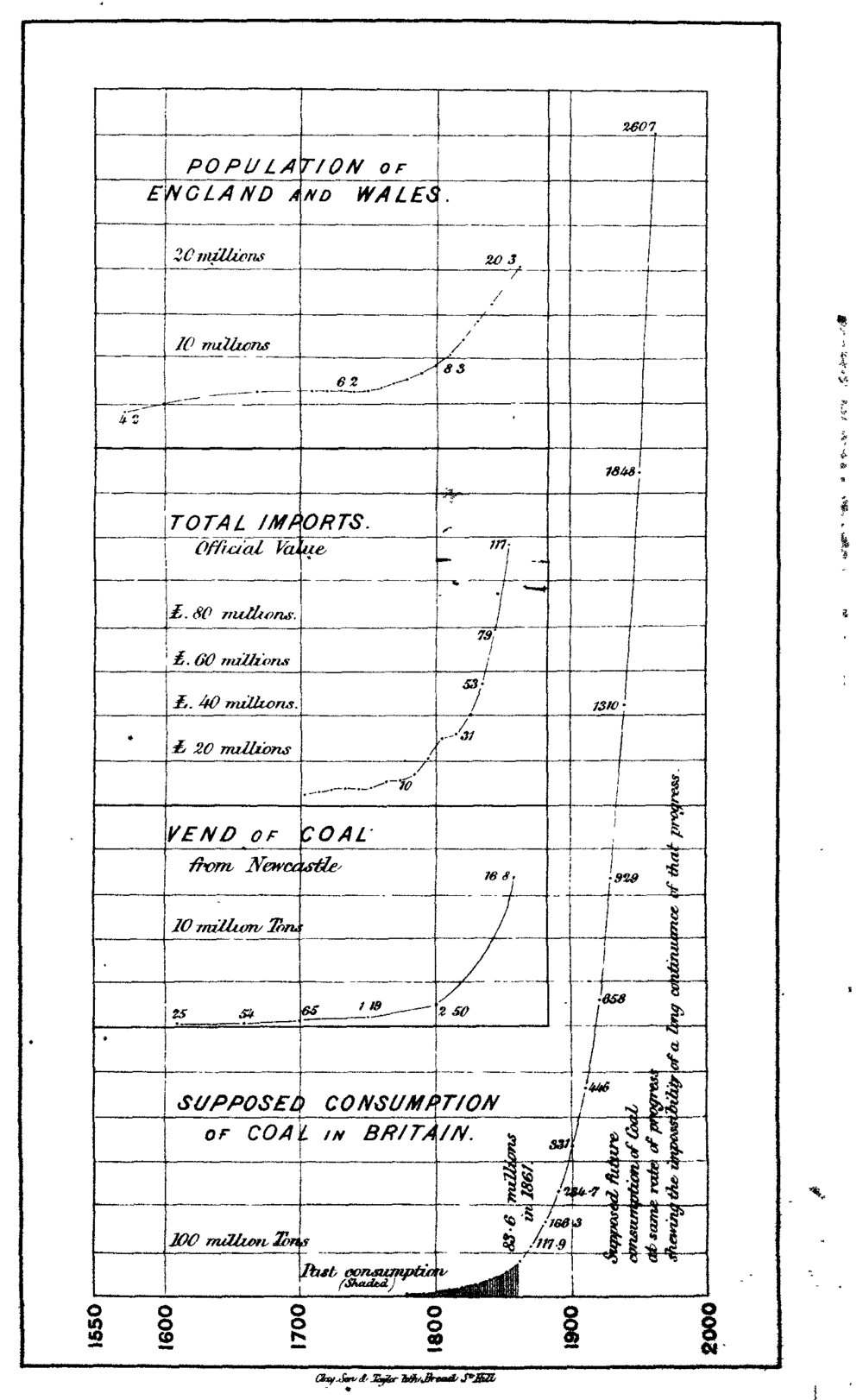
- The foldout diagram of the population of England and Wales is kept as a plate before the title page.
- Left out: the index, which is keyed to the original pagination, and the publisher's advertisement. Italics and small capitals are not reproduced.
- Errors remain. About 98 in 100 of the words agree with the scan's own text layer, but a wrong word that is also a real word would pass the checks.
Sources and credits
- Original book: W. Stanley Jevons, The Coal Question: An Inquiry concerning the Progress of the Nation, and the Probable Exhaustion of Our Coal-Mines, second edition, revised (London: Macmillan and Co., 1866). First edition 1865.
- Scan: the 411-page scan of the second edition distributed by Liberty Fund's Online Library of Liberty.
- Comparison text: The Coal Question at the Library of Economics and Liberty, also from Liberty Fund.
- Related: Armstrong's 1863 address, which prompted the book.
- Restoration: James Webster, Croftsware, November 2026. The text was read with the open-source Tesseract OCR engine running on a local machine, and typeset with WeasyPrint. Nothing was sent to an online service.