Armstrong's 1863 address on coal and progress (restored edition)
Sir William Armstrong's 1863 presidential address to the British Association at Newcastle: Britain's coal, the waste of it, and the case for efficiency. Transcribed from a scan.
- Author
- Sir William G. Armstrong
- Published
- 1863 (address)
- This edition
- 15 pages
- Check against
- Scan of the printed address
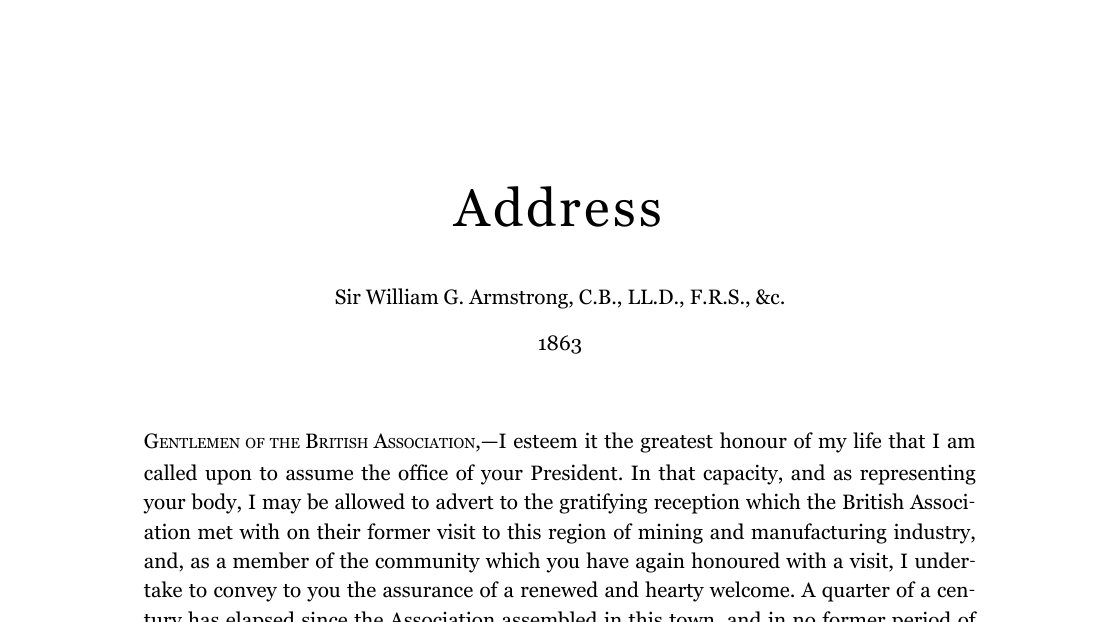
A reworked historic document. This is a reading edition, not the original. The address is out of copyright and the words are Sir William Armstrong's. The text was transcribed from a scan and checked against all fourteen pages, but it has been re-typeset, its line and page breaks are new, and a source-note page is added at the end, so it is not a facsimile. Spelling and wording are as printed. Check anything that matters against the scan. Download the restored edition (PDF, 15 pages), or the reMarkable edition, the same text at the reMarkable 2 screen size (157 × 210 mm) with black text, for reading on an e-ink tablet.
The speech
In the late summer of 1863 the British Association for the Advancement of Science met at Newcastle upon Tyne, and Sir William Armstrong, the engineer and industrialist, took the chair as its President. His opening address, of about 8,650 words, begins close to home. Newcastle, he says, is "the birthplace of railways", and the coal of the district had supplied the power for steam travel by land and sea.
From there it turns to coal. Armstrong treats coal as stored energy from the sun, and the water that drives machinery as another gift of the same source. He puts the coal in Britain's workable seams at about 80,000 million tons, which would last 930 years at the current rate of use, or 212 years if consumption kept rising as it had been. But the real question, he says, "is, not how long our coal will endure before absolute exhaustion is effected, but how long will those particular coal-seams last which yield coal of a quality and at a price to enable this country to maintain her present supremacy in manufacturing industry". Long before the coal ran out, he warns, other countries with larger and more accessible coal-fields, the United States above all, would be able to undercut British coal in every market.
His answer is efficiency. He argues that the steam engine uses heat uneconomically, that ordinary furnaces send most of their heat up the chimney and burn so imperfectly that gases escape with two-thirds of their heating power undeveloped, that smoke is "unnecessary and inexcusable", and that domestic fires are the worst of all: open fires burn about five times as much coal as a closed stove would for the same warmth. He points to Siemens's regenerative furnace as a remedy, describes the water power available from reservoirs such as the one at Greenock, and presses the case for proper records of what is mined.
The rest of the address ranges widely: the new dynamical theory of heat, recent work on the sun, Tyndall's experiments on water vapour in the air, weather forecasting, shorthand and telegraphy, standard weights and measures, and the discovery by Speke and Grant of the source of the Nile. It ends on a note of confidence in progress: "however high we climb in the pursuit of knowledge we shall still see heights above us".
Context
The British Association travelled to a different town each year, and the address says that a quarter of a century had passed since it last met in Newcastle, in 1838. Armstrong (1810 to 1900) ran the Elswick works on the Tyne, which had made hydraulic cranes and, since the 1850s, artillery.
The coal warning had a long afterlife. In The Coal Question (1865), the economist W. S. Jevons opens by saying that "the subject acquired new weight when prominently brought forward by Sir W. Armstrong in his Address to the British Association, at Newcastle, the very birthplace of the coal trade" (page 2). Jevons's book is restored and published here too. Armstrong's remedy was economy: burn coal more efficiently and the seams last longer. Jevons took the opposite view in his chapter on the economy of fuel: "It is wholly a confusion of ideas to suppose that the economical use of fuel is equivalent to a diminished consumption. The very contrary is the truth" (page 123). Better efficiency makes coal cheaper to use, so people find more uses for it and total consumption rises. That idea is now called the Jevons paradox, and it is the one I wrote about in The Three Mountains, where reaching a better state only raises what people ask for next, and in The End of Simplicity, where cheaper software means far more of it. This address is where that argument started.
Read it as a document of 1863. Its arguments about energy, waste and progress sit beside scientific explanations and social assumptions that belong to their period, and nothing here has been updated.
A small link to the other document in this collection: by 1901 the Newcastle firm that bore Armstrong's name, Armstrong, Whitworth and Co., was building steamers that John Foster Fraser met in Siberia.
What has been restored
- The text was transcribed from the fourteen-page scan (original printed pages li to lxiv) and compared page by page with both the scan's embedded text and a fresh machine reading. Differences were settled against the page images. That is 35 paragraphs and about 8,650 words.
- Original wording, spelling and paragraph divisions are kept, including forms such as "aëriform" and "connexion". Layout hyphenation is corrected, and running heads, original page numbers and the printer's signature are left out.
- The PDF was typeset from the transcription with Pandoc and WeasyPrint. It is searchable and its fonts are embedded. A direct TeX build of the source was not tested.
Sources and credits
- Original: Sir William G. Armstrong, address as President of the British Association for the Advancement of Science, Newcastle upon Tyne, 1863, printed on pages li to lxiv of the Association's report of that meeting.
- Scan: the fourteen-page PDF at nworbmot.org, with a page about the speech. Credit to Tom Brown for hosting it.
- Jevons: W. S. Jevons, The Coal Question (1865; second edition 1866), restored edition on this site.
- Transcription and restoration: James Webster, Croftsware, November 2026.